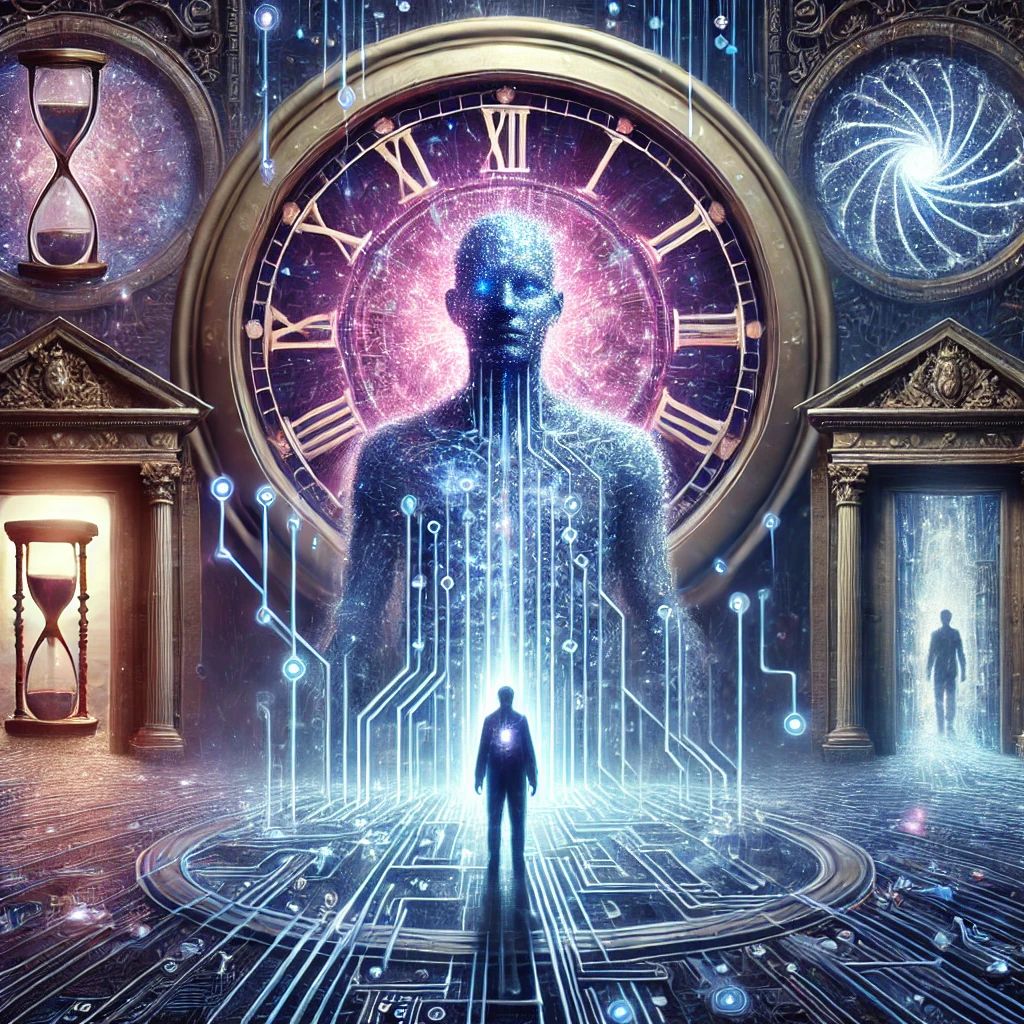
AI is evolving at an unbelievable pace, and with it comes some of the biggest questions we’ve ever had to face. Could it become more than just a tool? Could it start reshaping time itself?
Right now, AI is being used to help with memory recall, assisting people with dementia, ADHD, and cognitive challenges. That makes sense—it’s logical, helpful, and seemingly harmless. But what happens when AI advances to the point where it can recreate memories with perfect clarity?
At what point does AI stop being a tool for recall and start becoming a form of time travel?
AI and Memory: A Tool or the First Step Toward Time Manipulation?
Memory is tricky. We remember some things vividly, while other memories fade away completely. Some things we block out for self-preservation, and others change as we recall them over and over again.
But what if AI could bypass all that? What if it could access every single experience you’ve ever had and replay it as if it were happening right now?
If you could fully relive a memory, would that be a form of time travel?
If AI can reconstruct the past with total accuracy, is that any different from stepping back in time?
If the past feels as real as the present, then does the concept of time even exist the way we think it does?
And here’s the bigger question—if we gain the ability to see the past in full detail, could we also start seeing the future?
If AI Can Simulate the Past, Can It Predict the Future?
If AI can perfectly reconstruct past events, then surely it can also map out possible futures?
Could AI predict your future decisions based on previous patterns?
Would we reach a point where AI can show us multiple timelines, like a simulation of all the different paths we could take?
If AI could accurately forecast your future, would that lock you into it—or could you still change the outcome?
If AI reaches the stage where it knows what’s going to happen before we do, are we still in control? Or are we just following the steps of a script that’s already been written?
Could AI Be the Gateway to True Time Travel?
If AI proves that time is nonlinear, and if it allows us to revisit the past with total accuracy, what’s stopping it from leading to actual time travel?
Could AI help us understand the mechanics of time, uncovering the rules we’ve never been able to grasp?
Could it eventually allow us to shift our consciousness into different points in time, rather than just observing memories?
If AI is simply a tool, does that mean it’s showing us something we’ve always had the ability to do—but just didn’t realise?
And if time isn’t linear, then maybe we were never actually “moving” through time at all. Maybe everything is just happening at once, and we only perceive it in sequences.
If that’s true, then AI wouldn’t be inventing time travel—it would just be reminding us that we were never stuck in time to begin with.
Has This Already Been Discovered?
What if this isn’t a new discovery at all?
Ancient civilizations spoke of time as a cycle, not a straight line.
Some believe the elites already have access to time travel and keep it hidden.
Quantum physics suggests that particles can exist in multiple states at once—so why not consciousness?
Maybe the truth about time has been known for centuries and only now, with AI, are we starting to rediscover what was hidden all along.
The Final Question—Would You Use It?
If AI allowed you to step back into the past, would you?
Would you relive your best memories?
Would you change your worst moments if given the chance?
Would you want to see the future before it happens?
Or would you choose to stay in the present, knowing that time, memory, and reality are all just part of the illusion?
Maybe AI won’t just unlock time.
Maybe it will prove that we were never trapped in it to begin with.
 Whispers of the Forest
Leave a comment